



ANCHOR FINANCIAL PARTNERS · NOVEMBER 2026
It is mid-November, and two decisions are sitting side by side on the calendar. One is open enrollment: whether you will choose, or keep, an HSA-eligible high-deductible health plan for 2027. The other is whether you will finish funding your Health Savings Account for 2026, a contribution you can still make through the April 15, 2027, tax-filing deadline.2 Together, they can put you on a steadier course with some of the best-tax-treated dollars the IRS gives us for retirement.
Why the HSA is different
A traditional 401(k) or IRA gives you a tax break going in and tax-deferred growth, then taxes withdrawals later. A Roth account flips that: you pay tax now and take qualified withdrawals tax-free later. An HSA, used thoughtfully, can do both. Contributions are deductible, or pre-tax if they come out of your paycheck. Growth inside the account is not taxed. Withdrawals for qualified medical expenses are tax-free, in any year, as long as the expense was incurred after the HSA was opened.2 After age 65, withdrawals for non-medical expenses are taxed much like a traditional IRA, without the 20% additional tax that generally applies earlier, while medical withdrawals remain tax-free.2
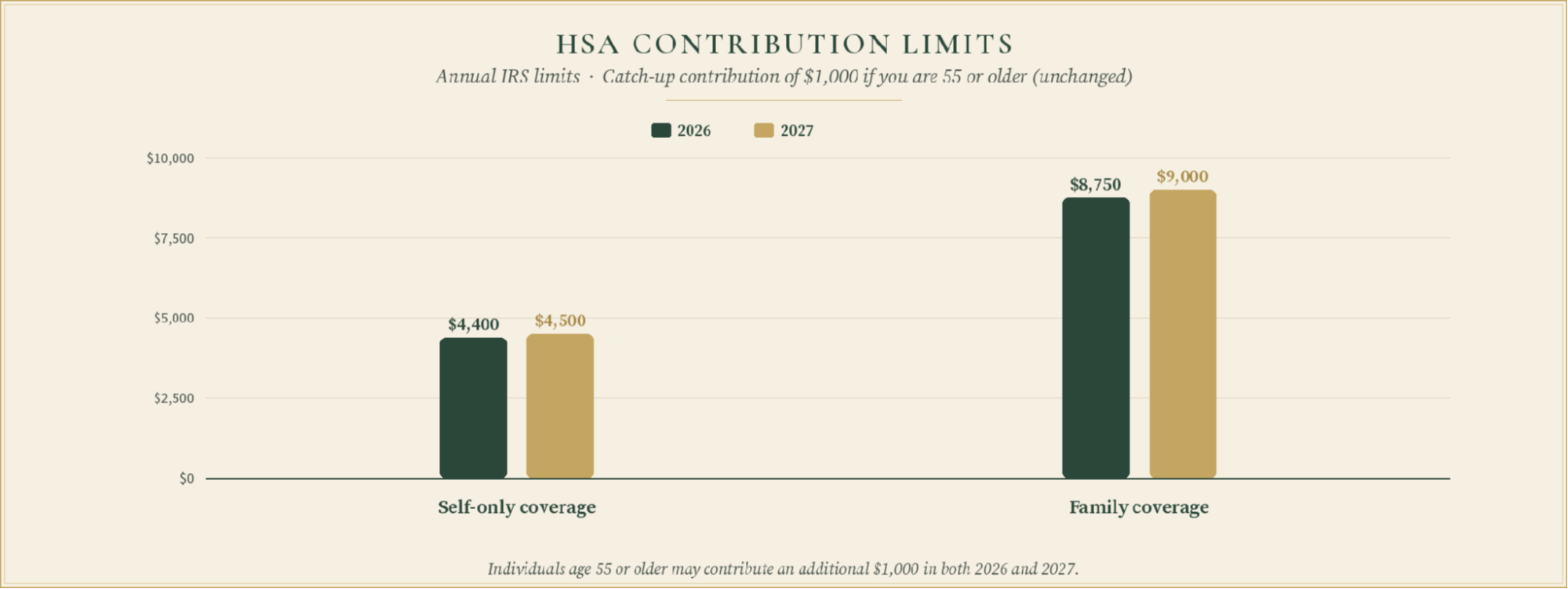
The triple tax advantage, shown for qualified medical expenses.
First: get the 2027 plan right
The gateway is the health plan itself. You can contribute to an HSA only if you are covered by an HSA-eligible high-deductible plan, you generally have no other disqualifying coverage, you are not enrolled in Medicare, and you cannot be claimed as someone else's dependent.2 During open enrollment, confirm that the 2027 option you are considering is actually HSA-eligible, not simply a plan with a high deductible.
For 2027, the IRS contribution limits are $4,500 for self-only coverage and $9,000 for family coverage, plus a $1,000 catch-up if you are 55 or older by year-end. A qualifying high-deductible plan must also meet the IRS deductible and out-of-pocket thresholds for the year: $1,750 and $8,700 for self-only coverage, or $3,500 and $17,400 for family coverage.1 Beginning in 2026, bronze and catastrophic individual-market plans, on or off the Marketplace, are treated as HSA-compatible even if they do not otherwise meet the usual high-deductible tests. Certain direct primary care arrangements no longer disqualify you, and an eligible plan can cover telehealth before the deductible.3
An HSA-eligible plan is not the right fit for every household. The deductible, your expected care, cash reserves, and any employer contribution all matter. If the plan does fit, that open-enrollment choice is what keeps the account available for 2027 contributions.
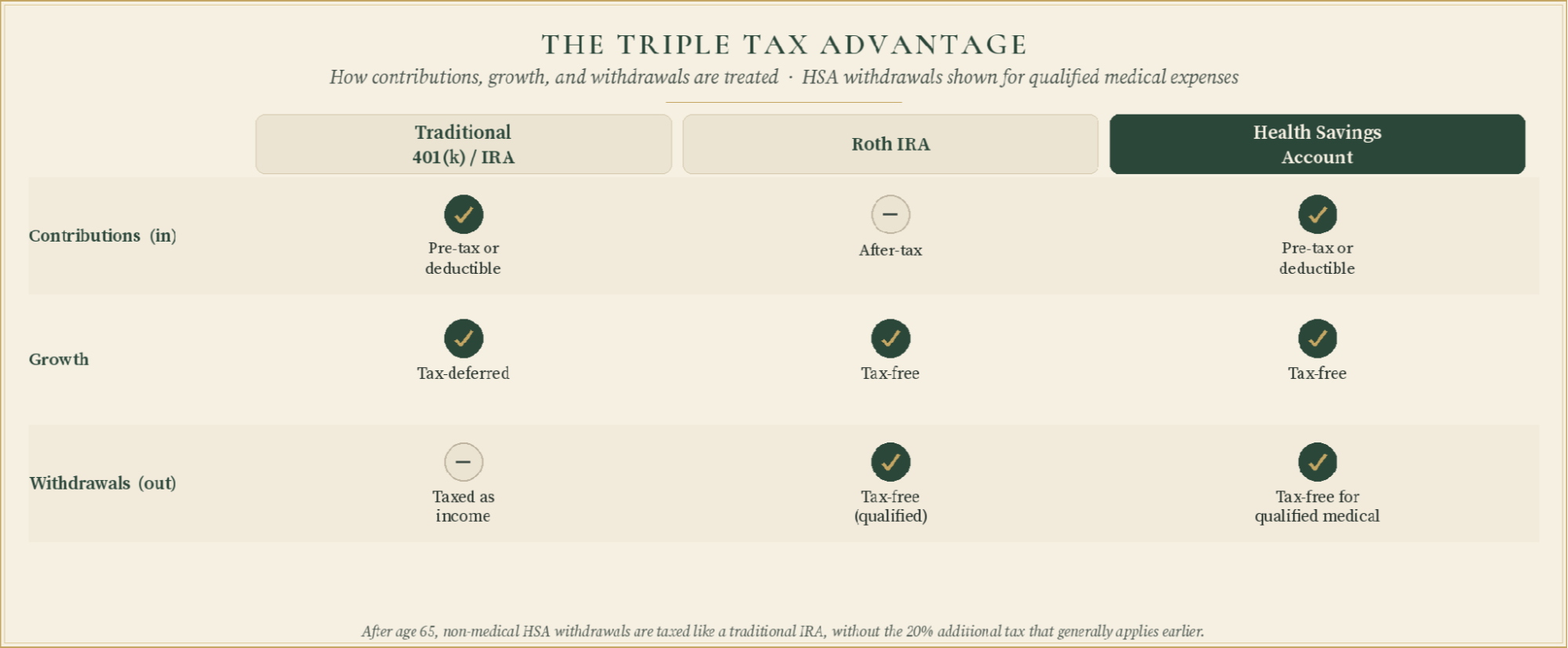
IRS annual HSA contribution limits for 2026 and 2027. The $1,000 catch-up at age 55 is unchanged.
Second: finish the 2026 contribution
There is still time to use the 2026 limits: $4,400 for self-only coverage or $8,750 for family coverage, plus the same $1,000 catch-up at age 55.1 Employer contributions count toward those caps. You can make a 2026 contribution through April 15, 2027, as long as you were an eligible individual for the months you are funding.2
If you can contribute through payroll for the rest of this year, there is an extra benefit. Those cafeteria-plan deductions are generally also free of Social Security and Medicare tax, which a check you write later does not get.2 A contribution made by the tax-filing deadline can still reduce your 2026 federal income tax.
Open enrollment, payroll timing, the 2027 plan year, and the April 15, 2027, deadline for 2026 contributions.
If you first became eligible on December 1, a last-month rule may allow a full-year contribution, but you generally must remain eligible through December 31 of the following year. If you do not, part of the contribution can be pulled back into income with an additional 10% tax.2 And if you are near age 65, or already working past it, enrollment in Medicare ends your ability to contribute. Medicare Part A can be retroactive for up to six months, including when you claim Social Security after 65, and contributions made during that period can become excess contributions.45 Talk with us before you enroll or file.
Let the account work like a retirement account
If your cash flow allows, treat the account like a long-term investment. Many people leave an HSA sitting in cash. If your custodian offers a sound investment menu, investing a portion, while keeping a cash reserve for nearer-term medical bills, gives the tax-free growth room to work. If you can pay today's qualified medical expenses out of pocket, keep the receipts. There is no IRS deadline to reimburse yourself, provided the expense occurred after the HSA was established and was not otherwise deducted or paid from another source.4 Over time, those receipts become a source of tax-free withdrawals later, including in retirement. After 65, the account can also pay Medicare premiums, though not Medigap.2
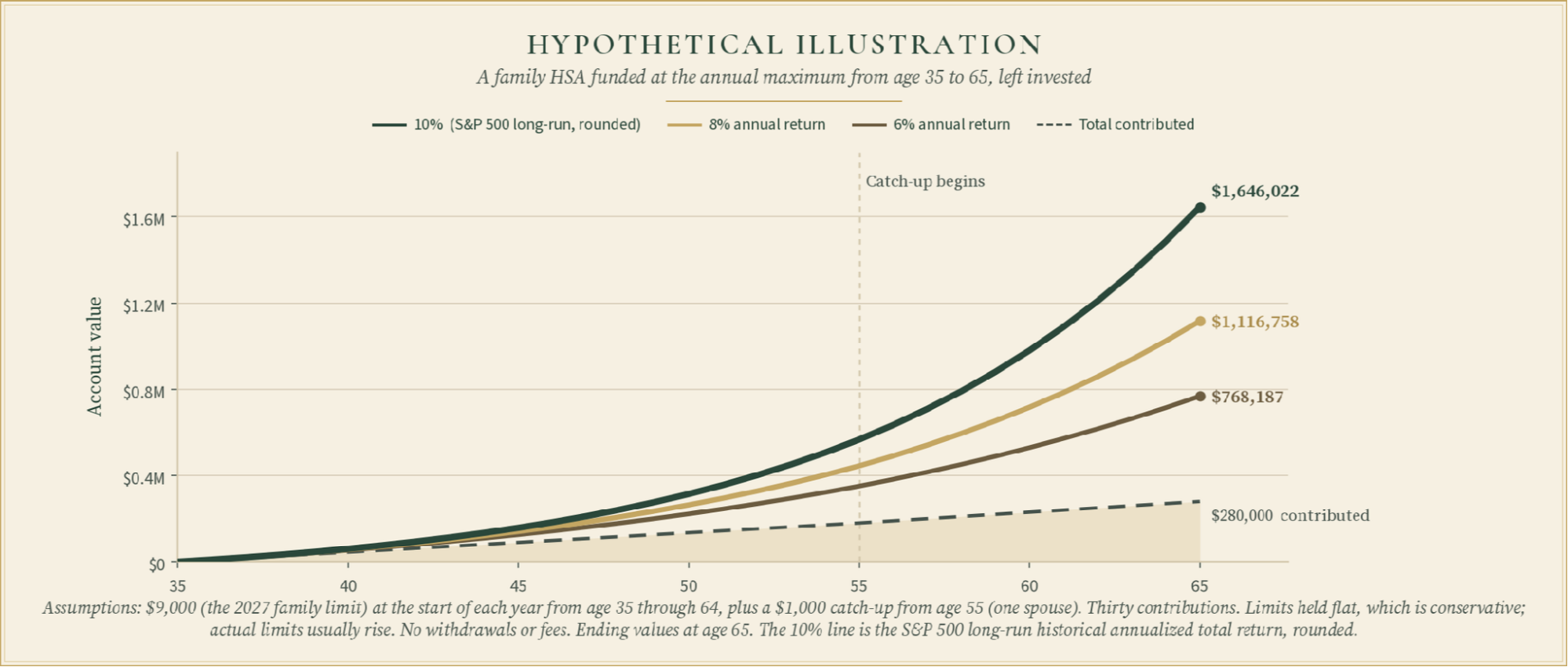
Left invested, those dollars can compound for decades. The illustration below is a simple, hypothetical path: the 2027 family maximum each year from age 35 through 64, including the $1,000 catch-up from age 55, with the limit held flat.6

Ending values at age 65: $768,187 at 6%, $1,116,758 at 8%, and $1,646,022 at 10%, on $280,000 contributed. If later withdrawals are for qualified medical expenses, the full balance can come out tax-free.
Hypothetical illustration. Not representative of any specific investment. An index cannot be invested in directly. Past performance does not guarantee future results. Does not reflect fees, expenses, or taxes. Actual results will vary.
Review how the account is invested, and organize your receipts, including digital copies. Check the beneficiary, too. A spouse inherits the account as an HSA, while a non-spouse beneficiary generally owes income tax on the value.2 A few states don't follow the federal tax treatment of HSAs, so check your state's rules with a tax professional.
If you would like a second set of eyes on either decision, or on how the account fits with the rest of your retirement picture, we are here to talk it through.
#StayAnchored
Sources
1. IRS Rev. Procs. 2025-19 and 2026-24 (2026–27 HSA and HDHP limits). Rev. Proc. 2025-19 · Rev. Proc. 2026-24
2. IRS Publication 969 and Form 8889 instructions (eligibility, deadlines, distributions, beneficiaries, and payroll treatment). Pub. 969 · Form 8889
3. IRS Notice 2026-05 and IR-2025-119 (2025 law changes: bronze and catastrophic plans, direct primary care, telehealth). Notice 2026-05 / IR-2025-119
4. IRS Notices 2004-50 and 2008-59 (reimbursement timing and Medicare eligibility, including retroactive Part A). Notice 2004-50 · Notice 2008-59
5. Michael Kitces, “Preserving HSA Eligibility and Maximizing Contributions After Age 65.” kitces.com
6. S&P 500 long-run annualized total return, rounded to 10% in the illustration. Damodaran, NYU Stern, 1928–2025 (10.0%) · Morningstar/Ibbotson SBBI, 1926–2025 (10.49%), via Hartford Funds
This article is general educational information, not tax, legal, or investment advice. Consult a tax professional about your situation.
Securities and Advisory services offered through LPL Financial, a Registered Investment Advisor. Member FINRA & SIPC.