



ANCHOR FINANCIAL PARTNERS · NOVEMBER 20, 2026
THE SHORT ANSWER
Most moves that can lower your 2026 tax bill have to be finished by December 31: workplace retirement contributions, required minimum distributions, charitable gifts, Roth conversions, and tax-loss harvesting. A couple of contributions can wait: you can still fund a 2026 IRA or HSA until April 15, 2027.
Every year around Thanksgiving, the questions we hear shift from the markets to taxes, and most of them come down to one thing: is there anything I should do before the year ends? Usually there is. This year the list looks a little different, because the tax law signed on July 4, 2025, changed several rules that start with 2026 returns, from a larger state and local tax deduction to a new charitable deduction for people who don't itemize.2,5
Here is the checklist we use, in plain English. Where a topic deserves more room, we've noted the article coming on a future Friday.
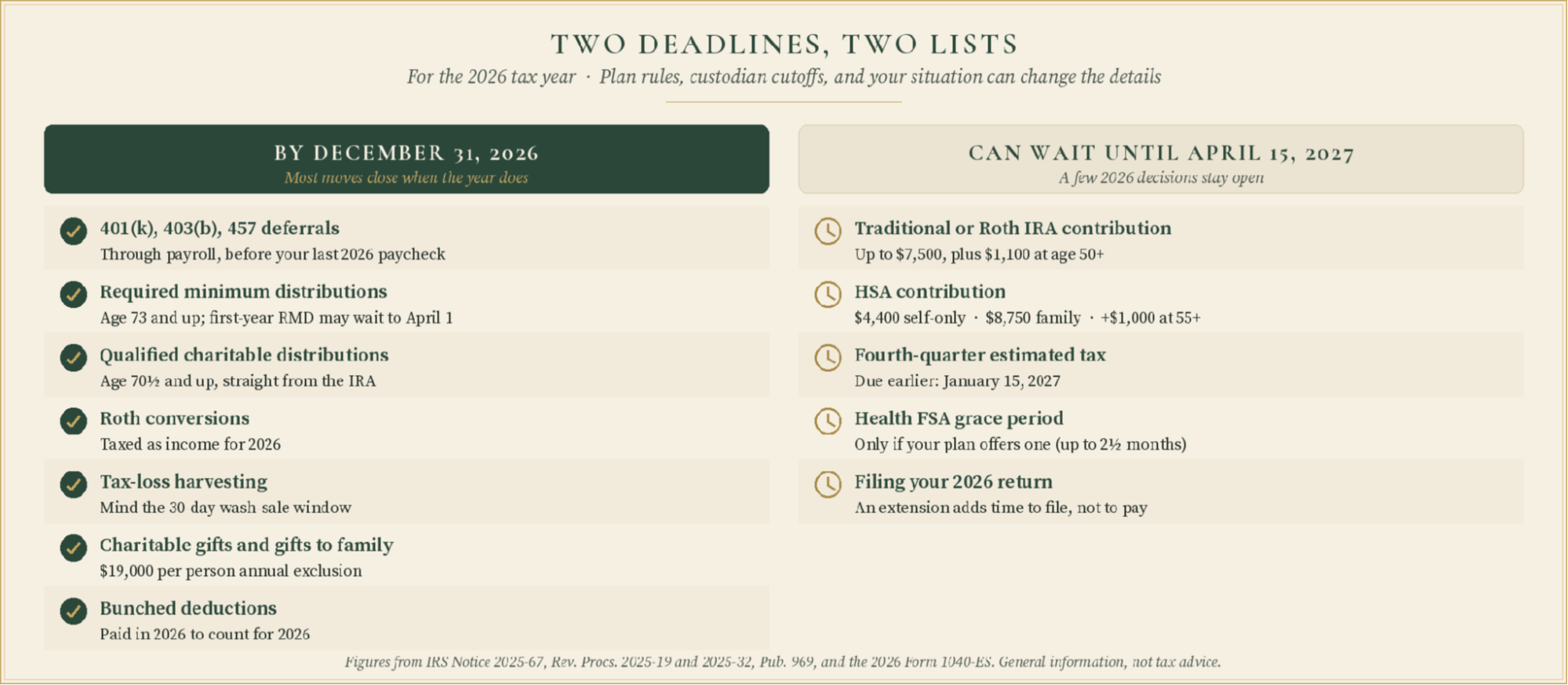
Most 2026 moves close on December 31. IRA and HSA contributions stay open until April 15, 2027.
The checklist: what to finish by December 31
1Top off your workplace retirement plan
Contributions to a 401(k), 403(b), or governmental 457 plan have to come out of a 2026 paycheck, so the real deadline is your last payroll of the year, not April. The 2026 limit is $24,500. If you're 50 or older you can add $8,000, and if you turn 60, 61, 62, or 63 this year the catch-up is $11,250 instead.1 One change to know about: if your 2025 Social Security wages from that employer were over $150,000, your catch-up contributions generally have to go in as Roth, after tax.1 If you're behind, ask payroll now whether you can raise your percentage for the checks that are left.
2Take your required minimum distribution
If you're 73 or older, you generally must take a required minimum distribution from traditional IRAs and most workplace plans by December 31. If you turned 73 this year, the first one can wait until April 1, 2027, but then you'll take two in 2027.6 A missed RMD can cost 25% of the shortfall, or 10% if it's corrected in time.6 Custodians get busy in December, so don't leave this for the last week.
READ MORE Coming Dec. 4: “RMDs and QCDs” · [link to be added]
3Give straight from your IRA if you're 70½ or older
Once you're 70½, you can send up to $111,000 in 2026 directly from an IRA to a qualified charity. The gift isn't included in your income, and it can count toward your RMD.1,6 For people who take the standard deduction, a qualified charitable distribution is often the cleanest way to give.
READ MORE Coming Dec. 4: “RMDs and QCDs” · [link to be added]
4Decide on a Roth conversion
Converting part of a traditional IRA to a Roth adds the converted amount to your 2026 income, so the tax is due now, and the conversion has to be completed by December 31 to count for this year.11 In exchange, the money can grow tax-free, and Roth IRAs have no required distributions during your lifetime.6 Conversions tend to make the most sense in lower-income years, such as the stretch between retirement and RMDs. The right amount depends on your bracket, Medicare premiums, and what else is happening on your return.
READ MORE Coming Dec. 11: “Roth conversions” · [link to be added]
5Harvest losses, carefully
If an investment in a taxable account is worth less than you paid, selling it can offset gains you've realized this year. If losses exceed gains, up to $3,000 can offset ordinary income ($1,500 if married filing separately), and the rest carries forward.7 Watch the wash-sale rule: buy the same or a substantially identical investment within 30 days before or after the sale, and the loss is disallowed for now.7
READ MORE Coming Dec. 18: “Tax-loss harvesting” · [link to be added]
6Give to charity with the new rules in mind
Charitable deductions change in 2026. If you take the standard deduction, you can now deduct up to $1,000 of cash gifts to qualified charities, or $2,000 if you're married filing jointly. Gifts to a donor-advised fund don't count toward it.5 If you itemize, only the part of your giving above 0.5% of your adjusted gross income is deductible, and for people in the 37% bracket the benefit of itemized deductions is capped at 35%.5 Whichever way you file, get a written acknowledgment for any single gift of $250 or more.10
READ MORE Coming Nov. 27: “Cash or stock: the smarter way to give to charity” · [link to be added]
7Bunch deductions if you're near the line
The 2026 standard deduction is $16,100 for single filers, $32,200 for married couples filing jointly, and $24,150 for heads of household. Add $1,650 for each spouse 65 or older, or $2,050 if you're single.2 If your itemized deductions land close to that number, bunching can help: concentrate two years of giving in one year and itemize, then take the standard deduction the next. The cap on state and local taxes is now $40,400. It phases down once modified AGI passes $505,000, but not below $10,000, which puts itemizing back on the table for more homeowners.4
If you're 65 or older, there is also a new deduction of up to $6,000 per person for 2025 through 2028, whether or not you itemize. It phases out above $75,000 of modified AGI, or $150,000 for joint filers.3
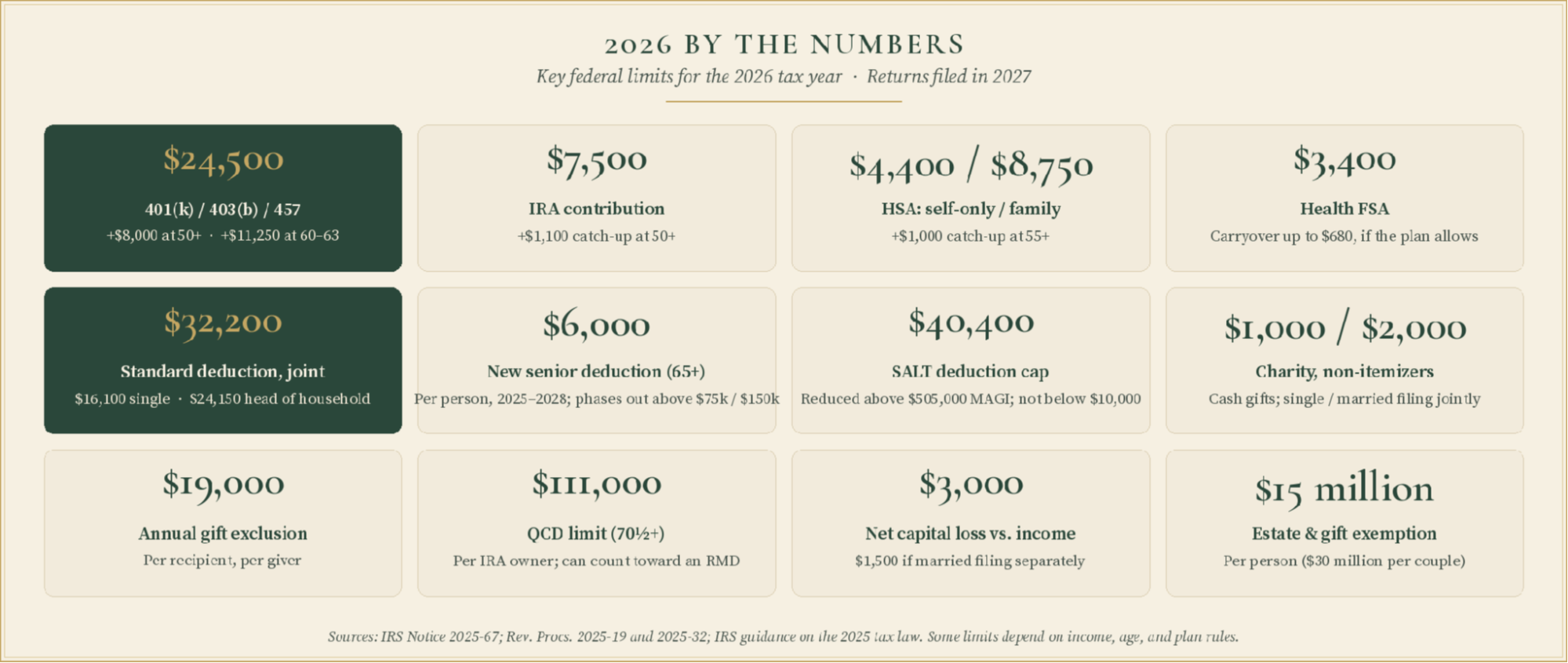
Key federal figures for the 2026 tax year. Some depend on income, age, and plan rules.
8Use what's left in your FSA
Health FSA money is generally use-it-or-lose-it. Your plan may offer a grace period of up to 2½ months or a carryover of up to $680 into 2027, but not both.8,2 Check which rule your plan uses, then book the eye exam or refill the prescription before the deadline. While you're in open enrollment, size next year's election to what you actually expect to spend.
9Check your withholding and estimated payments
If you expect to owe when you file, look now. You generally avoid an underpayment penalty if withholding and on-time estimates cover at least 90% of your 2026 tax, or 100% of your 2025 tax. That second test rises to 110% if your 2025 AGI was over $150,000 ($75,000 if married filing separately).9 The last 2026 estimated payment is due January 15, 2027.9 Withholding is treated as paid evenly through the year unless you show otherwise, so raising it on your last few paychecks can help you catch up.9 A large gain, a Roth conversion, or an RMD with nothing withheld are the usual culprits.
10Make annual gifts to family
In 2026 you can give up to $19,000 to as many people as you like without using any of your lifetime exemption, and your spouse can do the same. The gift has to be completed by December 31 to count for this year. The lifetime estate and gift exemption is now $15 million per person.2 If you're thinking about larger transfers, that is a conversation to have with us and your estate attorney.
11Get your records in order
Gather what you'll want in February: charitable receipts and acknowledgments, medical and HSA receipts, records of estimated payments, and cost basis for anything you sold. A folder now saves a scramble later.
What can wait until April 15, 2027
Two 2026 contributions stay open after the ball drops. You can make a 2026 IRA contribution of up to $7,500, plus $1,100 if you're 50 or older, until the April 15, 2027, filing deadline.1,11 The same goes for a Health Savings Account: up to $4,400 for self-only coverage or $8,750 for family coverage, plus $1,000 if you're 55 or older, as long as you were eligible.8 We covered the HSA in more depth last week.
READ MORE “Two Year-End Moves That Put Your HSA to Work for Retirement” (Nov. 13) · [link to be added]
And then, January
January brings new limits and a clean slate. On Christmas Day we'll close the series with the moves worth making early in the year and the 2027 numbers to plan around.
READ MORE Coming Dec. 25: “January moves and the new 2027 limits” · [link to be added]
None of these moves is right for everyone, and several of them interact. A Roth conversion, for example, can change whether a charitable gift is worth more this year or next. If you'd like help sorting out which items on this list matter for you, or want us to coordinate with your CPA, give us a call before the calendar fills up.
#StayAnchored
Year-end tax questions, answered
What is the deadline for year-end tax moves for 2026?
Most moves must be completed by December 31, 2026, including 401(k), 403(b), and 457 payroll contributions, required minimum distributions, qualified charitable distributions, Roth conversions, tax-loss harvesting, and charitable gifts. 2026 IRA and HSA contributions can be made until April 15, 2027.
Can I still contribute to an IRA or HSA for 2026 after December 31?
Yes. You can make a 2026 IRA contribution of up to $7,500, plus $1,100 if you are 50 or older, until April 15, 2027. Eligible HSA owners can contribute up to $4,400 for self-only coverage or $8,750 for family coverage, plus $1,000 at age 55 or older, by the same date.
What are the 401(k) contribution limits for 2026?
The 2026 employee limit for 401(k), 403(b), and governmental 457 plans is $24,500. Savers 50 and older can add a $8,000 catch-up, and those who turn 60, 61, 62, or 63 in 2026 can add $11,250 instead. Contributions must come out of 2026 paychecks.
Can I deduct charitable donations in 2026 if I take the standard deduction?
Yes. Starting with 2026 returns, people who do not itemize can deduct up to $1,000 of cash gifts to qualified charities, or $2,000 for married couples filing jointly. Gifts to donor-advised funds do not qualify.
What is the standard deduction for 2026?
The 2026 standard deduction is $16,100 for single filers, $32,200 for married couples filing jointly, and $24,150 for heads of household. Taxpayers 65 or older add $1,650 each if married or $2,050 if single, and may qualify for a separate senior deduction of up to $6,000 per person.
When is the fourth-quarter estimated tax payment for 2026 due?
The final 2026 estimated tax payment is due January 15, 2027. You can skip it if you file your 2026 return by February 1, 2027, and pay the full balance with it.
Sources
1. IRS IR-2025-111 and Notice 2025-67 (2026 retirement limits, catch-ups, Roth catch-up wage threshold, QCD limit). IR-2025-111 · Notice 2025-67
2. IRS IR-2025-103 and Rev. Proc. 2025-32 (2026 standard deduction, FSA, gift exclusion, estate exemption). IR-2025-103 · Rev. Proc. 2025-32
3. IRS, Working Families Tax Cuts: deduction for seniors. irs.gov
4. IRS, 2026 state and local tax deduction limit (Form 1040-ES correction). irs.gov
5. IRS charitable deduction for non-itemizers; 0.5% floor and 35% cap for itemizers. IRS reminder · Fidelity
6. IRS RMD FAQs and Publication 590-B (RMD age and deadlines, penalty, QCD age). RMD FAQs · Pub. 590-B
7. IRS Topic 409 and Publication 550 (capital loss limit, wash sales). Topic 409 · Pub. 550
8. IRS Publication 969 and Rev. Proc. 2025-19 (FSA grace period and carryover; 2026 HSA limits). Pub. 969 · Rev. Proc. 2025-19
9. IRS 2026 Form 1040-ES and Form 2210 instructions (safe harbor, due dates, withholding timing). Form 1040-ES · Form 2210 instructions
10. IRS Publication 526 (written acknowledgment for gifts of $250 or more). Pub. 526
11. LPL Financial, “Year-End Tax Planning: How Fall’s Decisions Shape Your Tax Bill.” lpl.com
This article is general educational information, not tax, legal, or investment advice. Tax rules are complex and change often, and your situation is your own. Consult your tax professional before acting on any of these ideas.
Securities and Advisory services offered through LPL Financial, a Registered Investment Advisor. Member FINRA & SIPC.